Industrial Powder Coating Company In Arizona | what goes into Industrial Powder Coating

Admin • July 14, 2026

Share this article

TL;DR

  • If you are looking for an Industrial Powder Coating Company, you need more than a shop that can apply color. You need inspection, repair, surface prep, coating selection, curing, and quality control.
  • What is industrial powder coating? It is a dry metal finishing process where powder is electrostatically applied to prepared metal, then cured with heat to create a durable protective finish.
  • Is powder coating better than paint? For many removable metal parts, yes. Powder coating is often more durable, more uniform, and better suited for trailers, frames, gates, railings, racks, equipment, and fabricated steel.
  • Do industrial parts need sandblasting first? Often yes. Sandblasting removes rust, mill scale, old coating, weld spatter, and surface contamination before coating.
  • Can large industrial parts be powder coated? Yes, when the shop has the oven size, rigging, blasting area, and workflow to handle the part.
  • Does powder coating prevent rust? It helps protect metal from corrosion when prep is done correctly, but it does not fix rust, cracked welds, bad fabrication, or contamination underneath.
  • What parts are good candidates? Trailer frames, flatbeds, equipment guards, machinery frames, commercial signs, gates, railings, racks, brackets, structural steel, and industrial assemblies.
  • Apex Powder Coating offers Powder Coating, Sandblasting, Custom Fabrication, and Large Item Coating for Arizona metal projects.

When you are searching for an Industrial Powder Coating Company in Arizona, you are not just looking for someone to spray powder on metal. You are looking for a shop that understands how industrial parts are used, how they fail, how they should be prepared, and how the finish needs to perform after it leaves the shop. Industrial powder coating is a full process. It includes inspection, repair, media blasting, masking, coating selection, application, oven curing, and final inspection.

That matters because industrial metal gets worked hard. Trailer frames flex and take road debris. Equipment guards get scraped and handled. Gates, railings, racks, and frames sit outside in the sun. In Arizona, metal also deals with heat, dust, wind, UV exposure, jobsite abuse, ranch use, and monsoon moisture. If the prep is weak, the finish is weak.

What Is Industrial Powder Coating?

Industrial powder coating is a protective metal finishing process used on commercial, industrial, agricultural, automotive, and heavy-use metal parts. Unlike liquid paint, powder coating starts as a dry powder. The powder is applied to grounded metal using an electrostatic charge, then cured in an oven until it melts, flows, and bonds into a hard finish.

For you, the benefit is practical. Powder coating can improve appearance, protect the surface, reduce corrosion risk, and create a cleaner, more professional final product. It is commonly used on steel, aluminum, fabricated metal, frames, brackets, racks, gates, railings, trailers, flatbeds, commercial signs, and industrial equipment parts.


Why Surface Prep Drives Industrial Coating Quality


TIGER Drylac, a major powder coating manufacturer, explains the role of media blasting in industrial pretreatment this way:


“Both techniques are ideal for large-scale applications or heavy-duty cleaning, providing a clean, textured surface that enhances powder coating adhesion.”

That is exactly why industrial powder coating should be viewed as a process, not just a finish. If the metal is still carrying rust, old coating, mill scale, weld spatter, oil, or shop contamination, the powder does not have the right foundation. For trailers, equipment frames, gates, railings, machinery parts, and large fabricated steel, the blasting and prep work often determine how well the final coating performs.


What Goes Into Industrial Powder Coating?


Step 1: Inspection


A good industrial powder coating project starts with inspection. Before anything is blasted or coated, the shop should look at the part’s size, material, condition, geometry, and use.

This includes checking for:

  • rust and corrosion
  • old paint or coating failure
  • cracked welds
  • bent tabs or brackets
  • mill scale
  • oil and grease
  • sharp edges
  • threaded holes
  • machined surfaces
  • rubber, plastic, seals, or wiring that may need removal or masking
  • whether the part can tolerate oven curing


This is where industrial work differs from a simple decorative job. The coating has to fit the part’s function.


Step 2: Fabrication or Repair


Industrial powder coating should not be used to hide bad metal. If a frame has cracked welds, if a trailer has bent tabs, if a gate has rust-through, or if a bracket is broken, those issues should be fixed before coating.


This is where fabrication and finishing work together. A shop that can repair metal before blasting and coating can help you avoid coating over problems that will come back later. In an industrial setting, this is not just about looks. It is about function, fitment, safety, and long-term value.


Step 3: Sandblasting and Surface Prep


For many industrial parts, sandblasting or media blasting is one of the most important steps. Blasting removes old coating, rust, mill scale, weld spatter, surface contamination, and other material that can interfere with adhesion.


It also creates an anchor profile. In plain terms, that means the metal surface has the right texture for the powder coating to grip. Without that profile, a finish can look good at first but chip, peel, or fail early.

This is especially important for Arizona projects because dust, heat, moisture, and outdoor exposure will expose poor prep quickly.


Step 4: Masking


Industrial parts often have areas that should not be coated. These may include threads, bearing surfaces, bolt holes, machined faces, hinge points, mating surfaces, or areas where coating thickness could affect fitment.


Masking protects these areas during coating. This step matters because a beautiful finish is not useful if the part no longer fits, bolts together, or functions correctly.


Step 5: Powder Selection


Not every powder is the same. An industrial powder coating company should help match the finish to the part’s use.


Important questions include:

  • Will the part be indoors or outdoors?
  • Will it sit in full Arizona sun?
  • Does it need corrosion resistance?
  • Does it need abrasion resistance?
  • Is color consistency important?
  • Should the finish be matte, gloss, satin, textured, or metallic?
  • Will the part be handled, dragged, bolted, washed, or exposed to chemicals?
  • Is this a structural, decorative, commercial, or high-use industrial part?


The right powder choice depends on the real environment, not just the color swatch.


Step 6: Application


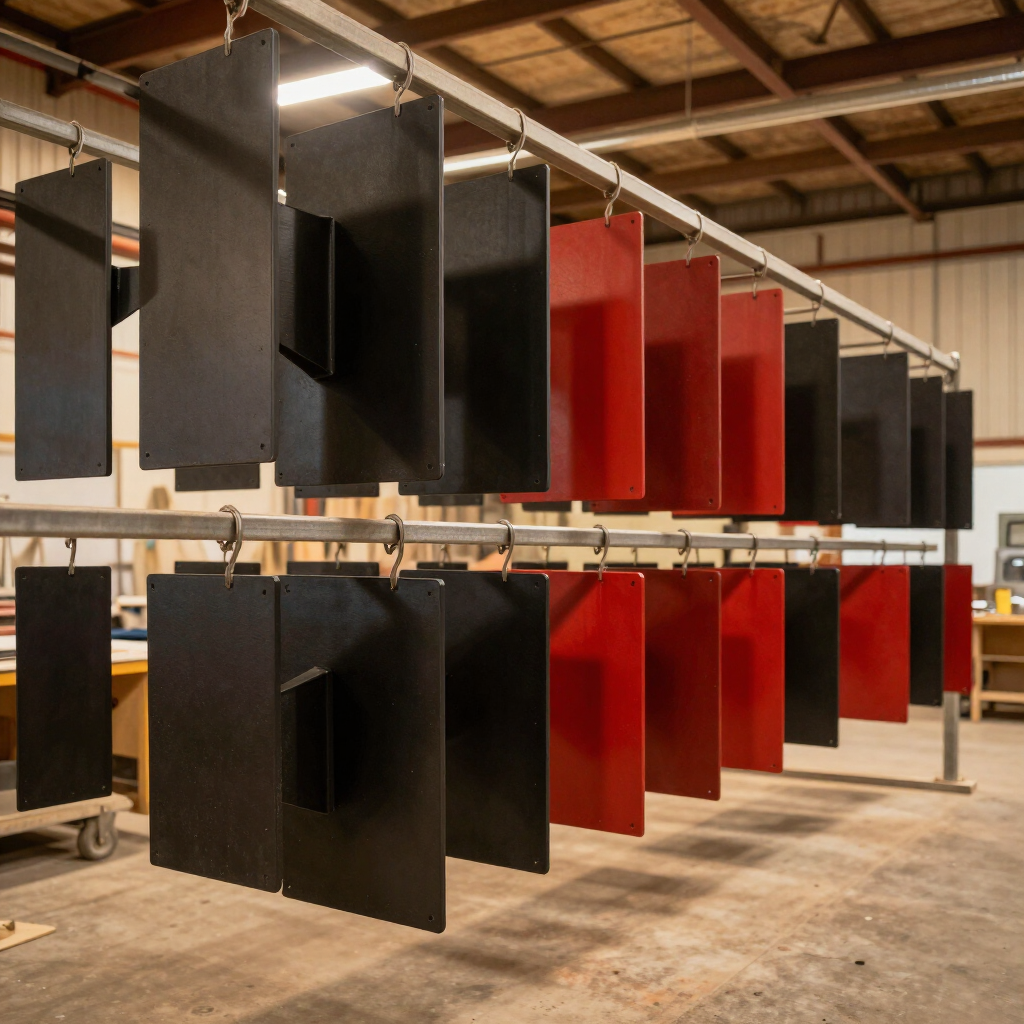
Once the part is clean, masked, and ready, powder is applied electrostatically. The powder is attracted to the grounded metal and must be applied evenly across edges, corners, welds, recesses, flat surfaces, and complex geometry.


Industrial parts can be challenging because they are often large, heavy, or awkwardly shaped. A simple bracket is one thing. A full trailer frame, gate assembly, flatbed, or machinery guard requires more planning, better racking, and more careful coverage.


Step 7: Oven Curing


Curing is where the coating becomes a finished surface. The coated part enters the oven and is cured according to the powder manufacturer’s requirements. During curing, the powder melts, flows, and chemically bonds to the metal.


This step requires the right oven size and consistent temperature. If a part is too large for the oven or has to be coated in sections, color consistency and coverage can become harder to control. For industrial powder coating, oven capacity is not a minor detail. It can determine whether the job can be done correctly.


Step 8: Final Inspection


Before the part leaves the shop, it should be inspected for coverage, color consistency, texture, missed areas, thin edges, surface defects, masking quality, and handling damage.


Final inspection is where the shop confirms that the part is ready for pickup and use. For industrial work, this is part of the value. You want a finish that looks professional and is prepared for real service.


Industrial Powder Coating vs Paint


Powder coating and paint both have their place, but they are not the same.


When Powder Coating Is Usually Better


Powder coating is often the better option when the part can be removed, blasted, coated, and cured. It is a strong fit for:

  • trailer frames
  • gates and railings
  • equipment frames
  • brackets and racks
  • machinery guards
  • commercial signs
  • steel wheels
  • architectural metal
  • ranch and agricultural equipment
  • industrial fabricated assemblies

Powder coating offers a durable, uniform, professional finish with many color, gloss, and texture options.


When Paint May Still Make Sense


Paint may be better for fixed structures that cannot be moved, field-applied coatings, quick touch-ups, or parts that cannot tolerate oven heat. The right choice depends on the part, the location, and the maintenance plan.

What to Look for in an Industrial Powder Coating Company


When you choose an industrial powder coating company in Arizona, look for more than color options.


You want a shop that can answer these questions:

  • Can you fit my part in your oven?
  • Do you sandblast or media blast in-house?
  • Can you repair cracked welds or damaged brackets before coating?
  • What powder do you recommend for outdoor Arizona exposure?
  • What areas need to be masked?
  • How do you inspect finished parts?
  • Can you handle large items, frames, gates, trailers, and industrial equipment?


A good shop should be able to explain the process clearly. It should also be honest about what needs repair, what needs prep, and what finish makes the most sense.


Why Industrial Powder Coating Matters in Arizona


Arizona makes coating decisions more important. Sun and heat can punish weak finishes. Dust and wind can wear on exposed metal. Monsoon moisture can find chips, seams, welds, and poorly prepped areas. Jobsite and ranch use can add abrasion, vibration, and impact.


For a decorative indoor part, small finish flaws may be mostly cosmetic. For an industrial part, those flaws can turn into corrosion, coating failure, downtime, or rework.


That is why the process matters. Inspection, fabrication repair, blasting, coating, curing, and final inspection all work together.


Common Questions About Industrial Powder Coating


How long does industrial powder coating last?


It depends on the prep, powder type, metal condition, environment, use, and maintenance. A properly prepared and coated part will generally perform much better than a part coated over rust, oil, or old failing paint.


Can powder coating be used outdoors?


Yes. Powder coating is commonly used for outdoor metal, but the powder type and prep process should match the exposure. Arizona sun, heat, and dust make that selection especially important.


Can rusted metal be powder coated?


Rusted metal should be cleaned and prepared first. In many cases, rust needs to be removed through sandblasting before coating. Severe rust, cracked welds, or rust-through may require fabrication repair.


Can industrial parts be coated as one piece?


Often yes, depending on the shop’s oven size and handling capacity. Larger assemblies need the right oven, racking, blasting setup, and workflow.


Final Thoughts


An industrial powder coating company should do more than apply powder. It should inspect the part, repair what needs to be repaired, prepare the surface correctly, select the right coating, cure it properly, and inspect the final finish.


For Arizona projects, that process matters. Industrial metal has to survive heat, dust, UV exposure, moisture, jobsite wear, ranch work, road debris, and real use. A finish that only looks good on day one is not enough.


For industrial powder coating, sandblasting, custom fabrication, and large item coating in Arizona, contact Apex Powder Coating for a free quote and clear guidance on the right prep, coating, and finish for your project.

Recent Posts

White metal building wall with a closed gray roll-up shutter door centered in the frame
By Admin July 17, 2026
Learn if you can powder coat aluminum, what materials can be powder coated, and how proper prep affects Arizona metal finishing projects.
Abstract dark metallic swirl with glossy black, silver, and pink highlights on a black background
By Admin July 11, 2026
Compare types of metal finishes, including powder coating, paint, galvanizing, anodizing, plating, and more for Arizona metal projects.
Worker welding metal on a scaffold indoors, with bright sparks flying in a dim workshop.
By Admin July 10, 2026
Learn what to know when searching metal fabrication near me in Arizona, including repair, sandblasting, powder coating, and finishing options.
Worker in blue rain gear and orange helmet sprays water at a smoky street scene behind caution tape.
By Admin June 28, 2026
Learn how to remove powder coat from metal, when chemical stripping works, and why media blasting is often the better choice for Arizona projects.
Close-up of metal roofing panels with rusted brackets and fasteners
By Admin June 28, 2026
Learn how media blasting works, compare aluminum oxide, glass bead, and steel grit, and choose the right abrasive for your Arizona metal project.
Close-up of a blue and purple textured mesh pattern with diagonal ridges and highlights
By Admin June 24, 2026
Learn when sandblasting is needed in Arizona, what materials need gentler prep, and how media blasting improves powder coating results.
Hands holding two small piles of bright yellow powder against a blue background
By Admin June 16, 2026
Learn how to powder coat at home, why DIY often fails in Arizona, and when professional powder coating, sandblasting, and prep are worth it.
Blue powder cloud exploding against a black background
By Admin June 10, 2026
Compare custom coatings, powder coating, and Cerakote-style finishes for Arizona projects, including use cases, durability, prep, and coating selection tips.
Mojave County Holbrook Complex sign with sunburst pillars, set in a desert landscape under a blue sky
By Admin June 9, 2026
Find out why powder coating Tucson projects need the right powder type, proper sandblasting, and expert prep for durable custom signs and metalwork.
Gloved hand spray-painting a car part in a paint booth
By Admin June 1, 2026
Learn how the right powder coating type affects durability, UV resistance, and finish quality for Arizona metal projects, including Mesa railings.
Show More